
Student Award
This award rewards outstanding CIRCA doctoral students.
2024 Awardee
Ismaël Djerourou, PhD student in Matthieu Vanni's laboratory
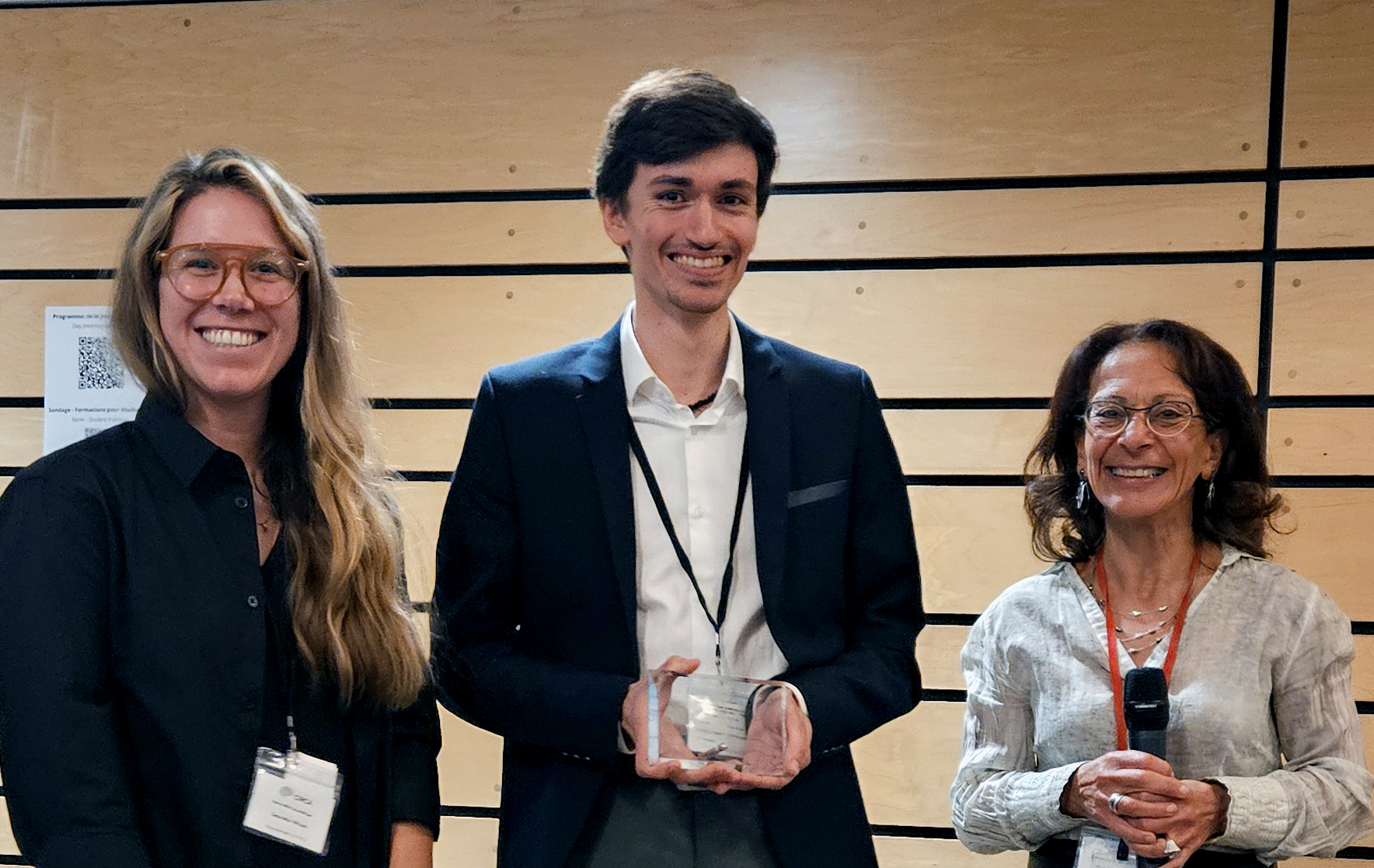
Left to right: Gabrielle Wilson (FRQS representative), Ismaël Djerourou, Arlette Kolta (CIRCA's director)
Ismaël's doctoral project
Do you remember the last time you were lost in thought? You probably thought nothing was happening in your brain. On the contrary, your brain was like a very violent storm where different regions were quickly activating. This activity is called spontaneous activity. We don't know its role very well, but we study it to better understand how different regions of the brain interact with each other. In people who have lost their vision in adulthood, it has been shown that during rest, spontaneous activity is different, especially in regions that normally process vision. However, little is known about the development of these changes and what happens in other states such as when we move. To address this issue, I study spontaneous activity in the cortex before and after the loss of vision in adulthood, in freely moving mice using a wide-field calcium imaging system.
2023 Awardee
Moustafa Nouh Badr, PhD student in Louis-Éric Trudeau's laboratory
Left to right: Louis-Éric Trudeau, Alima Alibhay (FRQS representative), Arlette Kolta (CIRCA's director), Moustafa Badr, Isabelle Archambault (CIRCA's adjunct director)
Moustafa's doctoral project
Parkinson’s disease (PD) is accompanied by altered function and progressive degeneration of substantia nigra dopamine (DA) neurons as well as other subgroups of neurons in the central and peripheral nervous system. Converging observations suggest that neuroinflammation and mitochondrial dysfunction play important roles in PD pathophysiology. However, their exact roles are still unclear. Our team recently discovered that loss of Pink1 or Parkin, involved in the genetic forms of PD, leads to immune dysregulation in the form of enhanced mitochondrial antigen presentation (MitAP). In Pink1 KO mice, the induction of MitAP occured following intestinal infection leading to the generation of autoreactive mitochondrial-specific T cells. This was associated with alteration of DA neuron terminals and L-Dopa-reversible motor impairments. A direct demonstration that such mitochondrial antigen specific T cells reach DA neurons in the intact brain and lead to their impairment is however still lacking. To assess the direct role of MitAP and mitochondrial antigen-specific T-cells, we adoptively transferred activated mitochondria-specific CD8+ T cells or control CD8+ T cells recognizing ovalbumin into wild type or PINK1 KO mice. The frequency, level of activation and brain infiltration of these T-cells was assessed using flow-cytometry. The integrity of the DA system was assessed by immunohistochemistry and PD-like symptoms were assessed using the pole test, grip strength test and open field. Activated mitochondrial antigen specific CD8+ T cells developed into central memory T-cells after adoptive transfer. Mice received mitochondrial specific CD8+ T cells showed impaired performance in the pole test, that can be reverted after administration of L-Dopa, open field and rotarod. The PD like pathology was found to be associated with infiltration of mitochondrial-specific CD8+ T cell in the brain. Preliminary data suggest that specific loss of DA neurons in the ventral midbrain and a reduction of their axon terminals in the striatum occurs in these mice. The present work supports the hypothesis that MitAP plays a role in the establishment of PD-like pathology in Pink1 KO mice via the response of mitochondria-specific T-cells. Moreover, the severity and progression of the disease seems to be linked to their infiltration to the CNS. This work could lead to the identification of new immunotherapies to treat PD.
This content has been updated on 15 May 2024 at 15 h 33 min.