Shared platforms
"Subject Interface" Platform
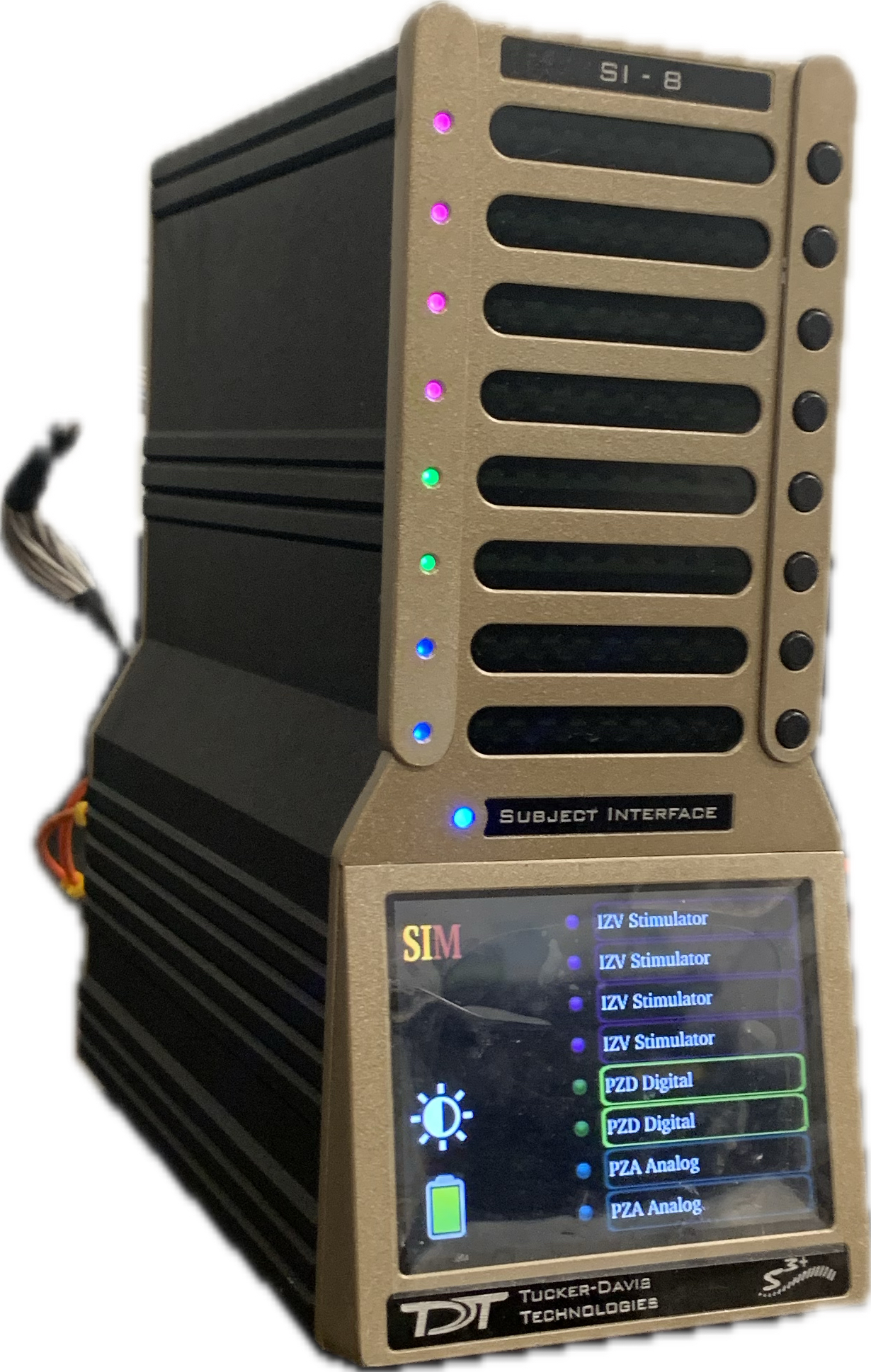
The Tucker-Davis Technologies "Subject Interface" device is a hybrid system that combines neurostimulation and biological signal recording (such as action potentials, muscle activity, etc.).
Its major feature is its ability to switch between recording and stimulation on the same electrodes in less than a millisecond, opening up innovative possibilities for neuroprosthetic protocols and electrophysiology. It is fully programmable in real-time, allowing adjustments in 5ms increments, and is compatible with all recording systems from the TDT "RZ" series (not included in the platform). It offers both analog and digital recording capabilities, capable of handling up to 256 channels simultaneously, and has four banks for electrical stimulation, with a total capacity of 64 channels. Additionally, the "switching headstage" is an innovation that enables rapid stimulation and recording on the same electrode, representing an advancement compared to previous systems.
The platform consists of the "Subject Interface," 1 x 64-channel analog headstage (primarily for stimulation), 2 x 32-channel digital headstages (for recording), and 1 x 32-channel Switching headstage (for both stimulation and recording).
Booking link
Current projects (as of 03/06/2024)
Brain-machine interface
Davide Burchielli, PhD student (Polytechnique Montréal). Supervision: Marco Bonizzato
Exploration of the involvement of the MLR (Mesensephalic Locomotor Region) in direct motor control, and application of the results to the implementation of closed-loop stimulation to restore motor deficits following cortical injury.
Comparison of intracortical and epidural stimulation
Alireza Aminian, PhD student (Polytechnique Montréal) and Matthieu Sayar, MSc student (Université de Montréal). Supervision: Marco Bonizzato and Marina Martinez
Comparison of intracortical and epidural stimulation through analyses of electromyographic and kinematic activity in rats, with the aim of establishing the efficacy of invasive stimulation.
Movement-coherent cortical stimulation
Alireza Aminian and Rima El Hassan, PhD students (Polytechnique Montréal). Supervision: Marco Bonizzato
Exploring the controllability of fine contra- and ipsilateral movements with intracortical microstimulation in awake rats to restore deficits due to spinal cord injury.
Neuro-robotic platform (NRP)
Émilie Théberge, MSc student (Polytechnique Montréal). Supervision: Marco Bonizzato and Numa Dancause
Design of a neuro-robotic platform to facilitate studies of reaching and grasping tasks in rats.
Mechanisms of cortical activation
Boris Touvykine, postdoctoral fellow (Polytechnique Montréal). Supervision: Marco Bonizzato
Characterization of movements evoked by intracortical stimulation, and the effect of stimulation parameters on forepaw movements in sedated rats.
Neuroprosthesis in the reward network
William Lata, MSc student (Université de Montréal). Supervision: Marco Bonizzato
Exploring the utility of the reward network as a therapeutic treatment to exploit and maximize recovery from motor system injuries.
Effects of simultaneous stimulation of the spinal cord and motor cortex
Lison Kardassevitch, PhD student (Université de Montréal). Supervision: Marco Bonizzato
Exploration of simultaneous stimulation of the spinal cord and motor cortex to control evoked movements in rats, and potential use as a therapeutic treatment after spinal cord injury.
Distributed neuroprosthesis (project under development)
Léo Choinière, PhD student (Université de Montréal). Supervision: Numa Dancause and Guillaume Lajoie
Stimulation and neuronal recording of the same cortical sites with minimal delay.
This content has been updated on 6 June 2024 at 14 h 21 min.